Exhibition MUJI Clothing Basics
Natural Colours — A Blessing from Nature
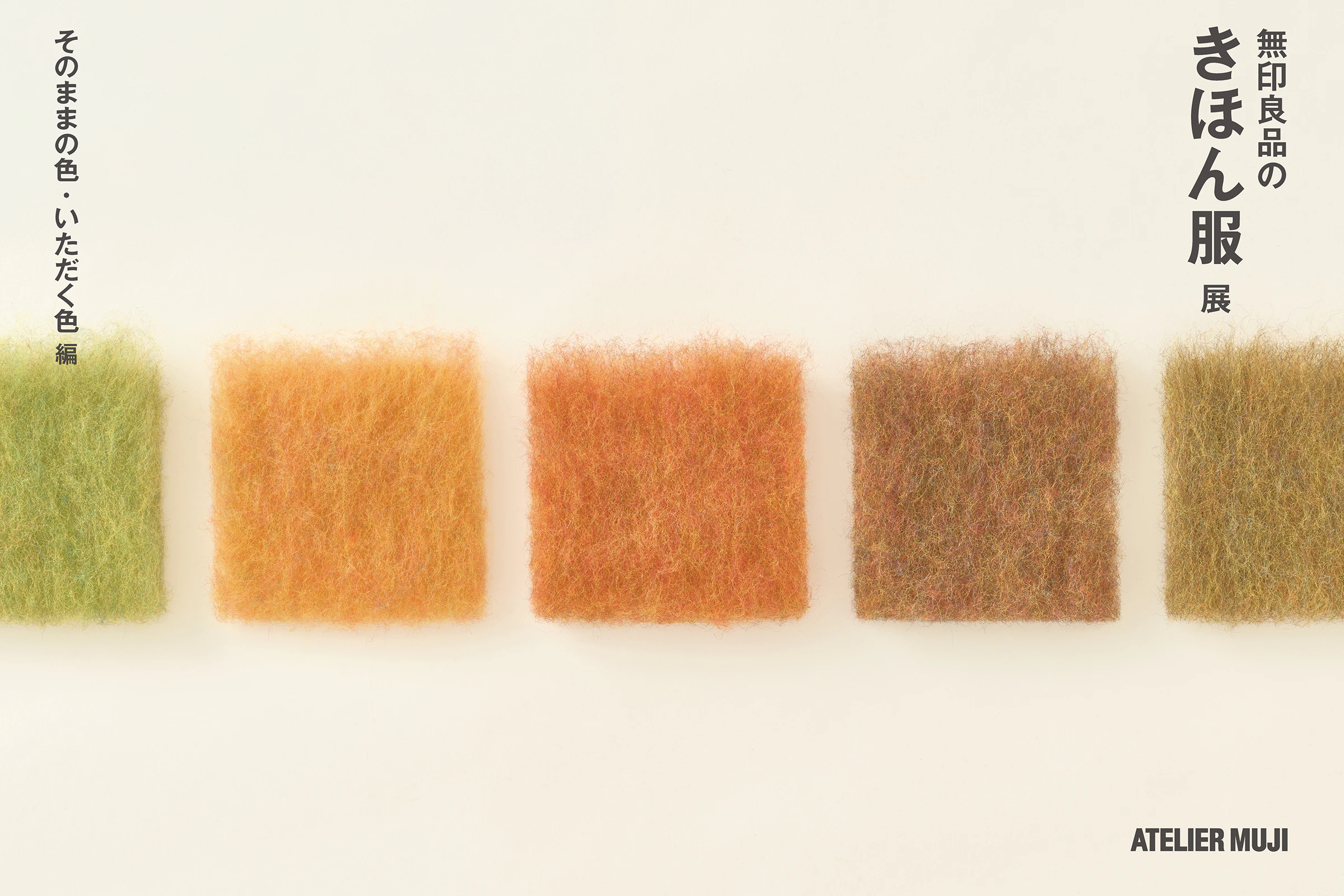
Flowers, leaves, animals, earth.
Every colour found in nature is one that no human hand could make. These are colours that were born, not created.
Since ancient times, people have marvelled at these colours, been moved by them, and have drawn them into daily life, often by copying them and combining them to make them their own.
When MUJI began making wool products in the 1980s, we simply gathered whatever raw fleece was available as a material. The whites and browns that varied from sheep to sheep became pullovers in their own natural colours, just as they were — and in doing so, revealed the rich hues that already existed within the material itself.
More than forty years on from that starting point, MUJI has further developed its philosophy around natural colours, and has widened its gaze toward colour itself.
This exhibition follows how colours born in nature met human wisdom and skill, and how this encounter then evolved into the clothing we know today.
To trace a colour is also to trace the relationship between nature and people.
We invite you to ponder the workings of nature, and the ingenuity of people, that lie behind every colour.
And perhaps, afterward, the colour of a familiar garment might seem a little different to you.
ATELIER MUJI
─────────────────────────────────────────────────
Hearing what things want to say
Colour is a language spoken by material things.
From the earliest times of cave paintings on through weaving and dyeing and traditions, humans have found ways to bring natural colourants into eloquent conversation with basic harvested materials like wool and hemp.
MUJI once championed "natural colour" as an aesthetic, asking us to appreciate materials in all their profound essential beauty. Yet the further I questioned our love of colour, the more I had to wonder whether wholly undyed "found material" hues were enough.
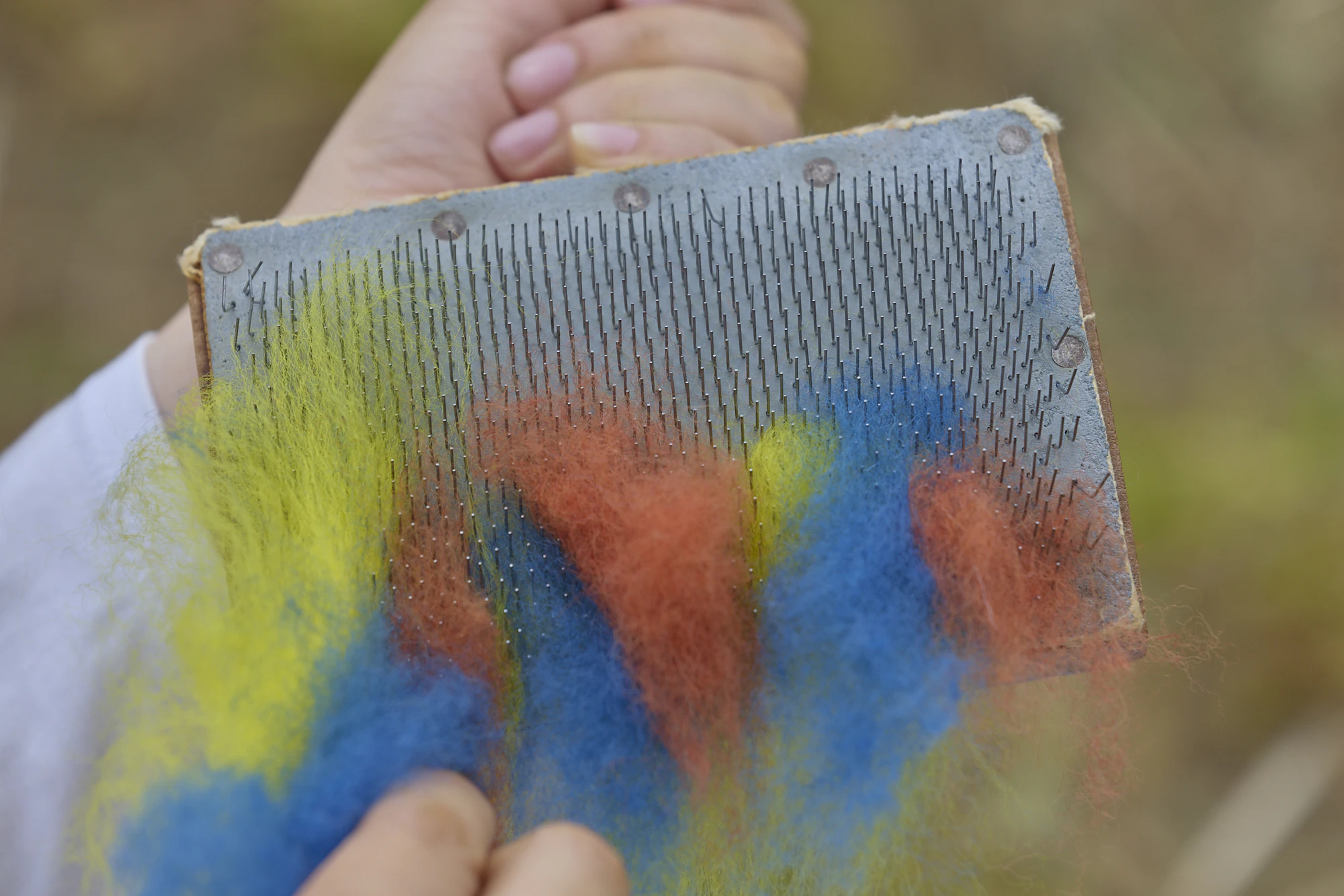
This time around, we have experimented with using only "three primaries": wild blue from Ryukyu indigo, elegant red from suo "sappanwood", and earthy yellow from obaku "Amur cork" herbal medicine. With just three natural dyestuffs and plain wool we can obtain an infinite variety of colours, a simple yet rich harmony that harks back to the origins of colour to which MUJI aspires.
"Natural colour" isn't just about undyed fibres; it's in how we engage with materials, learn from nature, and honestly present their stories. We hope the colours created by this pursuit will enliven and enrich your world.
Reiko Sudo(Textile designer, MUJI Advisory Board)
Time
11:00 – 21:00
- Open times and holidays follow the open hours and closed days of the store.
- Please note that some of the exhibits may not be available for viewing due to changes in the exhibition schedule or events.
Credits
- Organiser
- Ryohin Keikaku Co., Ltd.
- Cooperation
- Reiko Sudo
- Exhibition Design
- TAKT PROJECT Inc.
- Graphic Design
- SHIMA ART&DESIGN STUDIO
- Exhibit Production
- Shiori Ono, Eriko Seki, Tokyo Zokei University
- Video
- Shinsui Ohara
- Interview and Exhibit Cooperation
- Kanai Kogei, Hino-Seiyaku Corporation
- Exhibit Cooperation
- Toshiki Enomoto, Kanai Kogei, Daiju Goto, Katsura Takasuka, Sanae Tokita, Kenta Toyoumi, Hino-Seiyaku Corporation, Koji Murayama + AGC Inc.
- Construction
- HIGURE17-15cas
Events
Related Information
Tour Information
2024
【Tokyo】ATELIER MUJI GINZA
September 6 ,2024 (Fri) – September 23 (Mon)
https://atelier.muji.com/jp-en/exhibition/240906/
2025
– The Earth and Organic Cotton –
【Osaka】MUJI GRAND FRONT OSAKA Open MUJI
April 10 ,2025 (Thu) – April 30 (Wed)
https://atelier.muji.com/jp-en/exhibition/250410_osk/
2026
Natural Materials: The Earth and Organic Cotton
【Bangkok】MUJI Central World ATELIER MUJI BANGKOK
February 27, 2026 (Fri) – June 7 (Sun)
https://atelier.muji.com/jp-en/exhibition/260227/
2026
Natural Colours — A Blessing from Nature
【Tokyo】ATELIER MUJI GINZA
November 28, 2026 (Sat) – January 11, 2027(Mon)
https://atelier.muji.com/jp-en/exhibition/261128/
ATELIER MUJI GINZA
ATELIER MUJI, named by Ikko Tanaka, a graphic designer and former art director of MUJI, embodies the role of "a workshop that returns to the roots of living while seeking inspiration for the future." This forward-thinking initiative, envisioned by Ryohin Keikaku, serves as a cultural intersection, hosting curated exhibitions and events across diverse themes, including art and design.
